
Remote work and gender disparities in the Brazilian labour market

Keywords:
remote work, earnings, hours worked, gender differentiation, BrazilArticle Sidebar
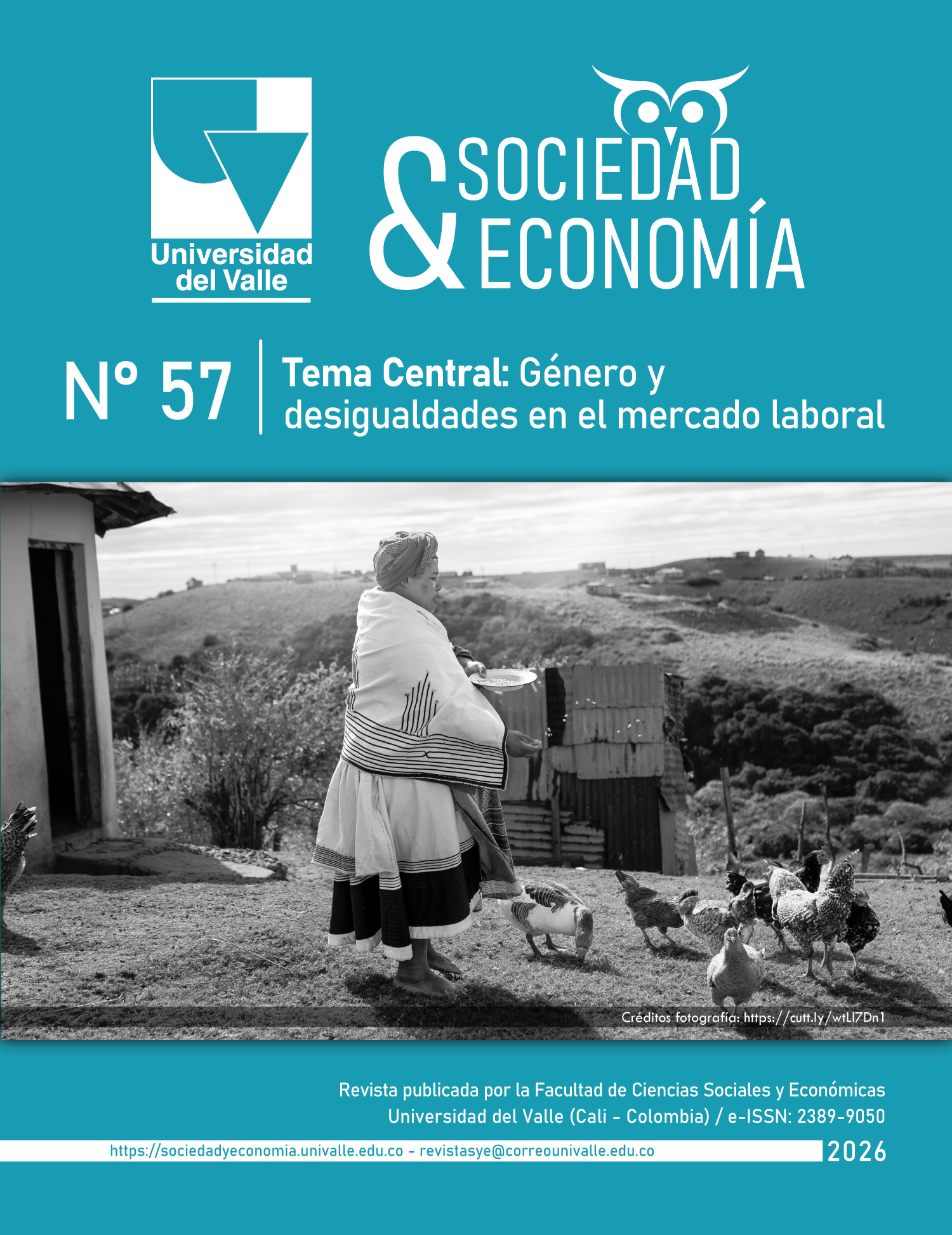
Main Article Content
This study explores gender disparities in wages and hours worked in the context of remote work, which saw a significant rise in frequency after the onset of the COVID-19 pandemic. For this purpose, data from the 2022 Continuous National Household Sample Survey (PNAD) was used. In this study, Mincer equations are estimated, followed by an analysis using the Oaxaca-Blinder decomposition to examine disparities in earnings and hours worked remotely between men and women. The results found a significant difference in favor of men regarding hourly earnings and hours worked remotely compared to women, which is not explained by the variables of interest. The results showed that one of the main factors explaining these differences corresponded to the sexual division of domestic labor, which penalizes women.
Abraham, R., Basole, A. and Kesar, S. (2022). Down and out? The gendered impact of the Covid-19 pandemic on India’s labour market. Economia Política, v. 39, n. 1, p. 101-128. https://doi.org/10.1007/s40888-021-00234-8
Alloatti, M. N. and Oliveira, A. L. M. de. (2023). Deepening and widening the gap: The impacts of the COVID‐19 pandemic on gender and racial inequalities in Brazil. Gender, Work & Organization, v. 30, n. 1, p. 329-344. https://doi.org/10.1111/gwao.12909
Antunes, E. D., Ribeiro, B. C., Santos, M. and Fischer, F. M. (2023). A ponta do iceberg: o teletrabalho durante a pandemia. Saúde e Sociedade, v. 32, n. 3, p. e220075pt. https://doi.org/10.1590/S0104-12902023220075pt
Beland, L-P, Brodeur, A., Mikola, D. and Wright, T. (2022). The short‐term economic consequences of COVID‐19: Occupation tasks and mental health in Canada. Canadian Journal of Economics/Revue canadienne d'économique, v. 55, p. 214-247. https://doi.org/10.1111/caje.12543
Belot, M., Choi, S., Tripodi, E., Broek-Altenburg, E. V. D., Jamison, J. C. and Papageorge, N. W. (2021). Unequal consequences of Covid 19: representative evidence from six countries. Review of Economics of the Household, v. 19, p. 769-783. https://doi.org/10.1007/s11150-021-09560-z
Blaskó, Z., Papadimitriou, E. and Manca, A. How will the COVID-19 crisis affect existing gender divides in Europe? Luxembourg: Publications Office of the European Union, 2020. https://data.europa.eu/doi/10.2760/37511
Bonelli, M. da G. and Marinho, R. (2020). Gênero, profissões e home office na pandemia. Contemporânea – Revista de Sociologia da UFSCar, v. 10, n. 1, pp. 443-455. https://www.contemporanea.ufscar.br/index.php/contemporanea/article/view/939/pdf
Bourdieu, P. (2020). A dominação masculina. Tradução Maria Helena Kuhner. RJ: Bertrand Brasil.
Borges, M. A., Piper, D. and Lopes, T. de A. M. (2023). Desigualdade de gênero no mercado de trabalho e a pandemia da Covid-19: uma análise dos impactos da crise no Brasil à luz da economia feminista. Disciplinarum Scientia| Sociais Aplicadas, v. 19, n. 1, p. 45-59, 2023. https://doi.org/10.37778/dscsa.v19i1.4320
Cirino, J. F. (2018). Discriminação por gênero no mercado de trabalho: uma comparação do diferencial de rendimento entre homens e mulheres para os anos de 2002 e 2014. Planejamento e políticas públicas, n. 51. https://www.ipea.gov.br/ppp/index.php/PPP/article/view/932/485
Costa, J. S., Barbosa, A. L. N. de H. and Hecksher, M. (2021). Desigualdades no mercado de trabalho e pandemia da covid-19. Texto para Discussão. https://repositorio.ipea.gov.br/bitstream/11058/10660/1/bmt_71_desigualdades.pdf
Cortes, G. M. and Forsythe, E. (2023). Heterogeneous labor market impacts of the COVID-19 pandemic. ILR Review, v. 76, n. 1, p. 30-55. https://doi.org/10.1177/00197939221076856
Collins, C., Landivar, L. C., Ruppanner, L. and Scarborough, W. (2021). COVID‐19 and the gender gap in work hours. Gender, Work & Organization, v. 28, p. 101-112. https://doi.org/10.1111/gwao.12506. Epub 202
Dang, H-A H. and Nguyen, C. V. (2021). Gender inequality during the COVID-19 pandemic: Income, expenditure, savings, and job loss. World Development, v. 140, p. 105296. https://doi.org/10.1016/j.worlddev.2020.105296
Dingel, J. I. and Neiman, B. (2020). How many jobs can be done at home? Journal of Public Economics, v. 189, p. 104235. https://doi.org/10.1016/j.jpubeco.2020.104235
Góes, G. S., Martins, F. dos S. and Nascimento, J. A. S. do. (2020). Teletrabalho na pandemia: efetivo versus potencial. Carta Conjunt.(Inst. Pesqui. Econ. Apl.), p. 1-7. https://www.ipea.gov.br/portal/images/stories/PDFs/conjuntura/200707_nt_48_teletrabalho.pdf
Góes, G. S., Martins, F. dos S. and Nascimento, J. A. S. do. (2020). O trabalho remoto nos setores formal e informal na pandemia. Carta Conjunt.(Inst. Pesqui. Econ. Apl.), p. 1-10. https://www.ipea.gov.br/portal/images/stories/PDFs/conjuntura/200921_cc48_nt_teletrabalho_nt.pdf
Heckman, J. (1979). Sample selection bias as specification error. Econometria. v. 47,
n. 1. https://doi.org/10.2307/1912352
Insfran, F. and Muniz, A. G. C. R. (2020). Maternagem e Covid-19: desigualdade de gênero sendo reafirmada na pandemia. Diversitates International Journal, v. 12, n. 2, p. 26-47. https://doi.org/10.53357/AMOC4868
Ielacher, M. and Koch, M. (2021). Working from home, wages, and regional inequality in the light of COVID-19. Jahrbücher für Nationalökonomie und Statistik, v. 241, n. 3, p. 373-404. https://doi.org/10.1515/jbnst-2020-0030
Jann, B. (2008). A Stata implementation of the Blinder-Oaxaca decomposition. Stata Journal, v. 8, n. 4, p. 453-479. https://repec.ethz.ch/ets/papers/jann_oaxaca.pdf
Joshi, H. C. and Kumar, S. (2023). Remote Work and Gender Inequality: Unmasking the Challenges and Seeking Solutions. IEEE Internet Computing. https://doi.org/10.1109/MIC.2023.3335614
Kosteas, V. D., Rena, F. and Scicchitano, S. (2022). Covid-19 and working from home: toward a ‘new normal’? https://www.econstor.eu/bitstream/10419/248570/1/GLO-DP-1013.pdf
Lee, S., Schmidt-Klau, D. and Verick, S. (2020). The labour market impacts of the COVID-19: A global perspective. The Indian Journal of Labour Economics, v. 63, p. 11-15, 2020. https://doi.org/10.1007/s41027-020-00249-y
Leite, A. R. and Sobreira, D. B. (2023). Gap de rendimentos por gênero no Brasil: o que mudou com a pandemia da covid-19? Planejamento e políticas públicas, n. 65. http://dx.doi.org/10.38116/ppp65art1
Lyttelton, T., Zang, E. and Musick, K. (2022). Telecommuting and gender inequalities in parents' paid and unpaid work before and during the COVID‐19 pandemic. Journal of Marriage and Family, v. 84, n. 1, p. 230-249. https://doi.org/10.1111/jomf.12810
Maeda, E., Nomura, K., Hiraike, O., Kinoshita, A. and Osuga, Y. (2019). Domestic work stress and self-rated psychological health among women: a cross-sectional study in Japan. Environmental Health and Preventive Medicine, v. 24, p. 1-11, https://doi.org/10.1186/s12199-019-0833-5
Matos, R. S., Machado, A. F. (2006). Diferencial de rendimento por cor e sexo no Brasil (1987-2001). Revista Econômica, v. 8, n. 1. https://doi.org/10.22409/reuff.v8i1.34918
Mincer, J. (1974). Schooling, Experience, and Earnings. Human Behavior & Social
Institutions, No. 2. https://www.nber.org/system/files/chapters/c3693/c3693.pdf
Nogueira, J., Góes, B. C., Andrade, J. M. S. and Alves, S. de S. (2022). Trabalho no contexto remoto: uma comparação entre gêneros. Revista Científica Multidisciplinar, v. 3, n. 2, p. e321117. https://doi.org/10.47820/recima21.v3i2.1117
Nwosu, C. O., Kollamparambil, U. and Oyenubi, A. (2022). Socio-economic inequalities in ability to work from home during the coronavirus pandemic. The Economic and Labour Relations Review, v. 33, n. 2, p. 290-307. https://doi.org/10.1177/10353046221085598
Oaxaca. R. L. (1973). Male-female wage diferentials in urban labor markets. International Economic Review, v. 14, 1973. https://doi.org/10.2307/2525981
OECD (2020), "Women at the core of the fight against COVID-19 crisis", OECD Policy Responses to Coronavirus (COVID-19), OECD Publishing, Paris, https://doi.org/10.1787/553a8269-en.
Oliveira, J. S. de and Kuwahara, M. Y. (2022). Mulheres negras na Pandemia de COVID-19. https://enep.sep.org.br/uploads/2076_1647114445_Mulheres_Negras_e_Covid_Brasil_identificado_pdf_ide.pdf
Palomino, J. C., Rodríguez, J. G. and Sebastian, R. (2023). The COVID-19 shock on the labour market: Poverty and inequality effects across Spanish regions. Regional Studies, v. 57, n. 5, p. 814-828. http://dx.doi.org/10.2139/ssrn.3775091
Pereira, B. C. J. (2016). Economia dos cuidados: marco teórico-conceitual. https://repositorio.ipea.gov.br/bitstream/11058/7412/1/RP_Economia_2016.pdf
Prates, I. and Barbosa, R. J. (2020). The impact of COVID-19 in Brazil: labour market and social protection responses. The Indian Journal of Labour Economics, v. 63, p. 31-35. https://doi.org/10.1007/s41027-020-00252-3
Salian, V. S., Wright, J. A., Vedell, P. T., Nair, S., Li, C., Kandimalla, M., Tang, X., Porquera, E. M. C., Kalari, K. R. and Kandimalla, K. K. (2021). COVID-19 transmission, current treatment, and future therapeutic strategies. Molecular pharmaceutics, v. 18, n. 3, p. 754-771. https://doi.org/10.1021/acs.molpharmaceut.0c00608
Susskind, D. and Vines, D. (2020). The economics of the COVID-19 pandemic: an assessment. Oxford Review of Economic Policy, v. 36, n. Supplement_1, p. S1-S13. https://doi.org/10.1093/oxrep/graa036
Tverdostup, M. (2023). COVID-19 and gender gaps in employment, wages, and work hours: Lower inequalities and higher motherhood penalty. Comparative Economic Studies, p. 1-23. https://doi.org/10.1057/s41294-022-00198-z
Wu, J., Zhan, X., Xu, H. and Ma, C. (2023). The economic impacts of COVID-19 and city lockdown: Early evidence from China. Structural Change and Economic Dynamics, v. 65, p. 151-165. https://doi.org/10.1016/j.strueco.2023.02.018
Downloads

This work is licensed under a Creative Commons Attribution-NonCommercial 4.0 International License.
Revista sociedad y economía editada por la Facultad de Ciencias Sociales y Económicas de la Universidad del Valle se encuentra bajo una Licencia Internacional Creative Commons Atribución - No comercial 4.0
Basada en una obra en http://sociedadyeconomia.univalle.edu.co